Are You Getting Enough Time with Your Healthcare Provider?

Who can relate to this? You’ve been dealing with pain, sickness, or some health scare for some time now, and you’ve finally decided it’s past the time of hoping it will spontaneously resolve. You decide it’s time to have this thing looked at by a pro. You line up all of your questions, book an appointment at their earliest opening (4 months from now!) and eagerly await answers and direction on what you need to do in order to address this nagging problem. The day of your appointment comes and you show up early. Then have to wait 45 minutes past your scheduled appointment time to get pulled back into the evaluation room. Lest not forget, you were lucky to only have to wait 45 minutes, because your cousin had to wait 2 hours at this very same office just 3 weeks ago. Then, your provider comes in, asks you what’s going on, listens to MOST of your story, then hurries the rest of the conversation along. After all, they have 8 other patients waiting in their respective rooms, or out in the lobby. It’s lunch time, and that provider has already seen 17 patients. You get your prescription for some medication and possibly some tests or imaging ordered, and you’re on your way – not much more certain of what’s going on than you were before that appointment.

Let us be clear, this is NOT good. You deserve more time with someone who knows how to help you. You deserve a thorough explanation of what the likely issue is (which requires a deep dive into your diagnosis – which takes TIME!).

Let’s be clear on this as well – this is very likely NOT your provider’s fault! They work in a system that is prioritizing quantity over quality. They work in a system that forces them to be more effective at time management than high quality diagnosis and getting to the root of people’s problems. IF they had more time to afford you and their other patient’s, they would be thrilled – AND THEY WOULD BE MUCH MORE EFFECTIVE AT HELPING YOU! Alas, sadly for them, this is not the system they get to operate within. They are constrained by a system that chokes each interaction, stifling the opportunity to build relationships and solve the deep problems that many patients are facing.

At WPT, we are trying like hell to change this narrative. Each and every one of our clinicians have been on the other side of the scenario described above. We’ve been limited, frustrated, and stressed that we’re not able to provide the care we know we could, only if we had more TIME to give. For this is the reason that WPT exists, and the reason each and every one of us has chosen to be on this side of healthcare history.

We’ve chosen a different path. Have you been frustrated by a scenario like the one described above? Our guess is you have. If you’re ready for someone to give you the time to listen, get to the bottom of your problems, and solve things for good, call us. We’re here for you.

Hop Test Variations

Return to sport tests are common at WPT and taking patients through tests that are validated by evidence is really important. Today we want to talk about a few tests that we use. Lower extremity injuries typically consist of two sides, the involved and uninvolved side. The difference between these two is simple. The involved side is the side that is injured and the uninvolved side is the side that is not injured. The rule of thumb here is that the outcome of your return to sport testing needs to be within 10% of your uninvolved side to safely return to athletics. Below are four validated tests commonly used at WPT as a gauge for return to sport.

Single Hop Test
This test is simple. The patient stands at the end of the measuring tape on one leg, and hops as far as they can using the uninvolved leg. Next we have the patient do the same but using the involved side. We test on both sides to see if the patient has comparable distances within 10%. For example, to meet the 10% threshold, if an individual can hope 30 inches on their non-injured side, they should be able to hop at least 27 inches on their injured side. Of the four listed tests, this is the only one time maximal effort power test.

Triple Hop Test
The principle for this test is the same as the single hop test, however this time there are three hops instead of one. Athletics most always require multiple bursts of dynamic activity, and this test reflects that aspect better than a single hop test.

Crossover Hop
This third test is is similar to the three hop test but instead of hoping straight, the patient hops in a zig-zag pattern over the ruler. The lateral movement aspect of this test requires additional levels of lower extremity stability and power.

6 Meter Timed Hop Test
The fourth and final test is a timed test to determine how quickly you can unilaterally hop in a six meter distance. If you are uncertain you’re ready to return to your sport after an injury, seeking out a physical who’s capable of determining your readiness is crucial to your recovery. The worst thing that can happen is getting back to your sport prematurely and suffer a re-injury!

If you have any question about return to sport tests or injuries, please feel free to reach out to us. We are always here to help!

4 Tips for Runners

Spring has sprung and this means the weather is getting warmer, which we can all agree is amazing! With warmer weather comes an uptick in outdoor sports — running being one of our favorites at WPT. So, if you find yourself running in this beautiful weather we wanted to give you some tips to help reduce your risk of injury and keep you going!

1. Warm-up!

It is important to prime your body for movement before starting to run in order to allow your body to move through the complete range of motion necessary and prepare the muscles to activate properly with every stride. Warm-ups should be dynamic allowing the body to move through various motions to allow the muscles and joints to move appropriately. Here’s an example of a pre-running warm-up: air squats, butt kicks, high knees, jumping jacks, vertical jumps, & walking lunges. Simply complete each of these for 1-2 minutes continuously before tying up those laces and going for a jog!

2. Progress Distance Gradually

If you are just beginning to run for the first time of the season after the long winter, then it is key to make sure you start small then build up your mileage over several weeks and months. In running, there is something called the ‘Ten Percent Rule’ this means that per week the mileage you are running should increase by no more than 10% from one week to the next! This rule is a quick and easy way to reduce your risk for injury when increasing your mileage.

3. Hydrate Properly

When you begin running, you will undoubtedly sweat — with this loss of fluid you need to make sure you are replacing this fluid through drinking plenty of water. Generally, it is recommended to drink 8 glasses of water per day, however knowing that both exercises (sweating) and the outdoor heat can cause fluid loss make sure you up this intake by a glass or two when upping your mileage to prevent dehydration!

4. Cross Train

Running is an awesome form of exercise for our cardiovascular fitness, however ensuring that we are training out muscle for strength and control is also important. So, for runners it is key that we integrate a handful of resistance exercises several times a week. Key muscle groups to strengthen for runners include the gluteals, hamstrings, quadriceps and the core.

If you have any questions about how to safely start a running program or how to reduce your injury risk with running come see us at WPT!

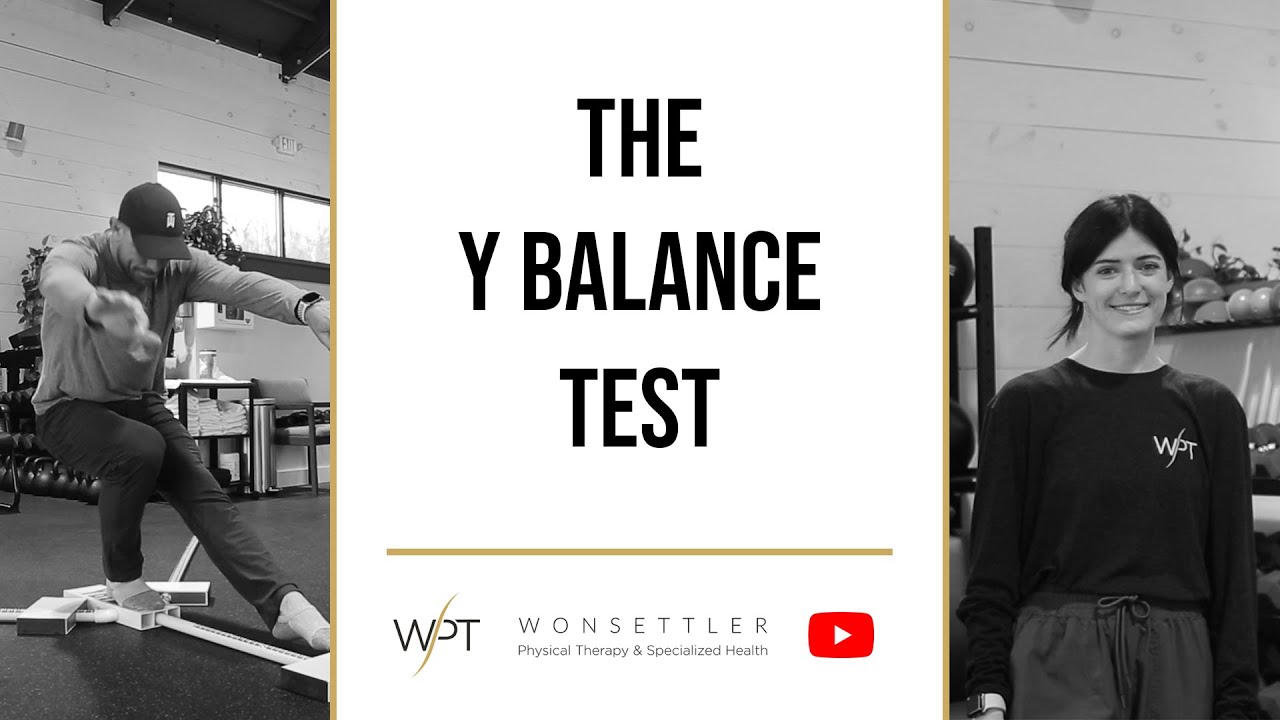
The Y Balance Test

Over the next few weeks we want to touch on returning to sports, specifically in the lower extremities. There are a lot of different tools that we use during treatment at WPT, but for athletes that need to return to sports, one of the many tests we utilize for return to sport testing is the Y balance test. This test is part of a functional movement screen that is used to determine balance and functional symmetry which in turn can help a physical therapist assess if the athlete is ready to return to their specific sport.

At WPT, we do not believe in band-aid solutions and we always want to make sure we are thorough, that’s why this test is so important. We want to look past just doing basic movement tests and look at the nuances of what it means to return to the particular sport in question. This test is a good measure of the asymmetry between an athlete’s injured side and non-injured side and making sure that their range of motion is safe and appropriate before returning to sports. That’s why this, and several other return to sport tests, are so important.

This is a simple, yet reliable test to measure dynamic stability. It requires the athlete to balance on one leg while simultaneously reaching as far as possible with the other leg in three separate directions: anterior, posterolateral, and posteromedial. This test measures the athlete’s strength, stability, and balance in various directions and can be predictive for risk of injury.

We know that it is important to feel ready to return to sports, but it is equally as important for an athlete to prove they are ready. We plan to continue this topic next week so stay tuned!

Internal Vs External Locus of Control

In our last blog we talked about fixed mindset vs growth mindset and provided insight on how to transition from a more fixed oriented mindset to a growth oriented mindset. We want to continue on this topic because, like we’ve said 1000 times, the way in which we think will impact the way we physically feel. At WPT, we know this to be true, and strive to impart this truth to all of our patients. The most effective treatment addresses MIND, body, and spirit.

Today’s focus on this topic is comparing internal vs external locus of control. These are psychological terms that describe two different mindset realities. The first is what’s called an external locus of control. People who have an external locus of control believe that successes or failures are a direct result of external factors beyond their control. These factors can include luck, fate, circumstance, injustice, and bias. In contrast, people who have an external locus of control believe that their successes and failures are a result of their own abilities.

On a daily basis, it seems that almost 90% of things that happen are outside of our control; something that we have no influence over. Some people focus on that 90%. They focus on things that they cannot change and it dictates their thoughts, emotions, and feelings which can ultimately dictate how they feel physically. On the flipside, there are people that focus on the 10%. These are the 10% of things that are within your control. It seems like these are the people that have things figured out. They have an understanding of what objectives they want to accomplish and how to go about getting there because they have a clear sense of how this 10% will influence other things.

The challenge for you is figuring out where you have a blind spot. What areas of your life are you giving too much energy and import to things that are outside of your control? Where can reign that in, flip the script, and focus on the things that you do have control over?

Here’s to a stronger, more resilient you!

Fixed Mindset VS Growth Mindset

Growth mindset vs fixed mindset. We covered this topic last week and we would like to keep talking about it today. If you recall from our last post, we talked about author and PHD Carol Dweck who coined the term “Growth Mindset”. Framing your mindset has a huge impact on your ability to achieve your goals.

Today we would like to compare a fixed mindset to a growth mindset and give some examples of different scenarios where having a growth mindset can be beneficial. We also want to show you that you can shift your mindset from a fixed mindset to a growth mindset.

1. Challenges. If you have a fixed mindset, when you come across a challenge, you are going to shy away from it. This is just going to be your natural way of dealing with these problems. If you have a growth mindset, you are going to face challenges head on and welcome them.

2. Obstacles. If you come across an obstacle and you have a fixed mindset, you are going to give up easily. If you have a growth mindset, you’re going to persist in the face of those obstacles and overcome them.

3. Effort. If you have a fixed mindset, you are going to view effort as fruitless, too much work, or even detrimental. However, if you have a growth mindset you’ll see effort as the path to mastery and something that is necessary to take you where you want to go.

4. Criticism. If you have a fixed mindset you are going to resist useful negative feedback. However, if you have a growth mindset you will actually be open to hearing critiques because this feedback will help you to grow and improve.

5. Success. If you have a fixed mindset, you will feel threatened by the success of other people. This is natural but it is important to realize that with a growth mindset, you can actually look for the lessons and find inspiration in the success of other people.

So our challenge to you is to analyze and be very critical about where you fall in those five different categories and see if you have more of a fixed mindset or a growth mindset. The reality is, this is a spectrum — in some situations we may have more of a growth or fixed mindset. An important lesson to learn is that we can put effort into moving ourselves from fixed to growth in more situations without our lives. The more we do this, the more opportunities will present themselves and the better that we’ll be able to deal with things that come our way.

How you think will impact your physical wellbeing. We know this to be true at WPT and we want to continue to talk about this topic so stay tuned!

Mindset Coaching Introduction

Every Friday morning at WPT, the therapists come in a bit early and have an hour long meeting. The purpose of this meeting is to discuss different ways we are going to improve our treatment, and continue to evolve as clinicians – which in turn helps our patients regain the freedom to move. During these meetings the therapists take turns leading the meeting around a research topic they’ve been studying. This week was Macy’s turn.

Macy’s recent research has focused on mindset coaching. At WPT, we believe that if you are going to make a transformational jump from where you are to where you want to be, you cannot just address your physical state. You need to be addressing your mental game as well. We want to help you frame things differently in your mind and see yourself overcoming your situation. If you can tell yourself a different, positive story, you can change your mindset and evolve your thinking.

What was covered today was research done in the 1970s by psychologist and educator, Carol Dwect. Carol is the person that coined the phrase “growth mindset”. There are two juxtapositions ideologies here; fixed mindset and growth mindset. Fixed mindset insinuates that intelligence is static. Your thinking doesn’t really change, and your ability to evolve is limited. A growth mindset is the notion that you can improve your resilience and tell yourself a different story. Your thinking can change your situation for the better. At WPT, we strongly believe that a growth mindset is not only possible, but the best way to operate, helping you overcome the obstacles that stand in your way.

In the coming weeks we will go more in depth about this topic and really compare fixed vs growth mindset as well as talk about ways that you can shift your thinking.

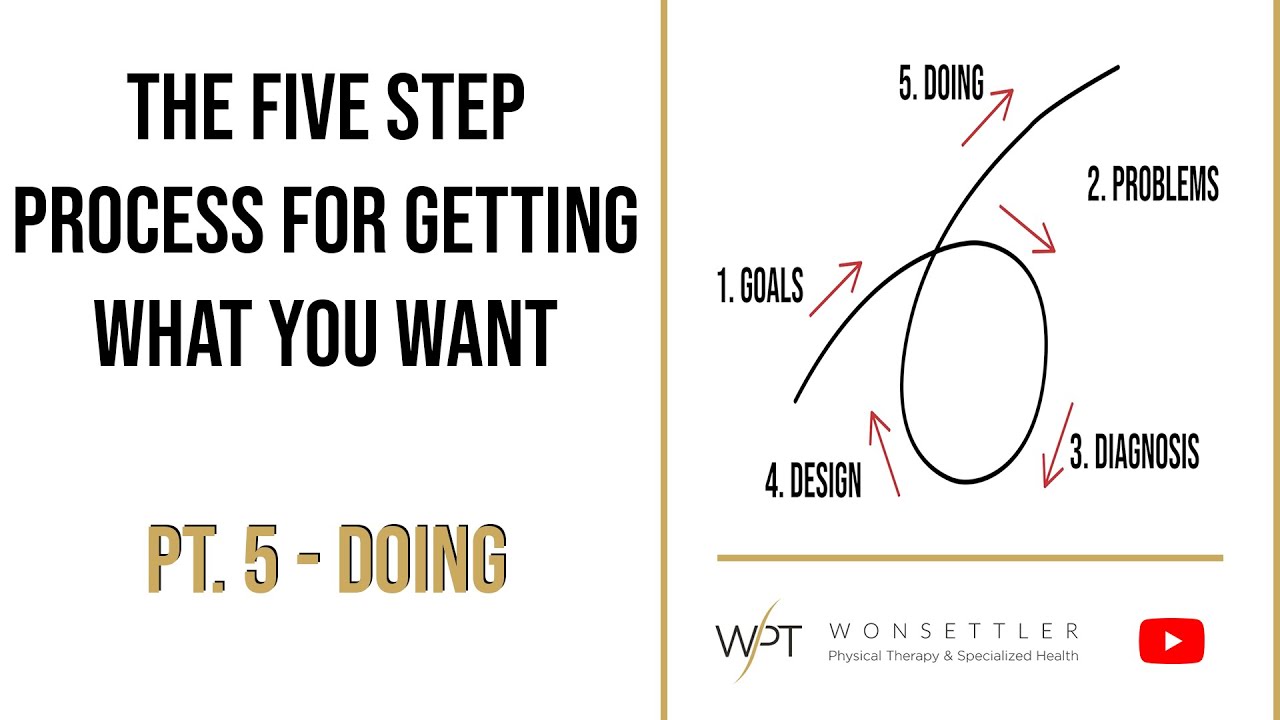
Doing!

This step is probably the most straightforward step, as well as being quite possibly the hardest. On one hand, the hard work of figuring things out is done. It takes a lot of emotional fortitude to work through the first 4 steps. However, it takes the ultimate self discipline to do the work set before you. And keep doing it. Without quitting. Great planners who don’t execute their plans go nowhere.

This is all about habits. We all have habits, and we have a lot of them. Some of them serve us well, and help us move in the direction we want. Other habits are killing us, figuratively and sometimes even literally.

You almost certainly will not be able to do all of these 5 steps well. And that’s ok. Almost no one has the ability or aptitude to do all 5 of these things at a very high level. For example, goal setting requires higher level thinking skills like visualization and prioritization. Identifying and not tolerating problems requires you to be perceptive and good at information synthesis. Diagnosing well requires you to be logical and methodical. The doing part requires self discipline, a results oriented focus, and good work habits. I know I certainly don’t have all of these qualities in spades, and you probably don’t either. That’s ok! Weaknesses don’t matter if you find solutions and workarounds for them.

That’s a wrap for the 5 step process for getting what you want. We hope this has been helpful for you! We would love to interact with you about your journey with the 5 step process. Please like and subscribe – we would love to hear from you!

Staying in the Game

WPT presents Staying in the Game, a free injury prevention workshop for female athletes age 12-21. The goal of this workshop is to help educate female athletes on injury prevention within the lower extremity; Including the ankle, hip, and knee joints!

This workshop will review the basic anatomy of the lower extremities, the most common injuries that occur, and specific exercise programing to minimize the risk for injury. After an informative presentation, those in attendance will be placed into breakouts where they will be assessed on their deep squat, box jump, and Y-Balance test. These tests will give our PTs an opportunity to assess movement. For example, if a participant is doing the deep squat test and their knees are collapsing in, the PT will be able to provide cuing to correct this movement pattern as well as provide exercises to allow enhance strength into the deep squat position. At WPT we do not take a “one size fits all” approach and we want to bring the same philosophy to our workshops. We want to bring an Individualized understanding of participants’ unique movement patterns.

This clinic will give female athletes an understanding of how their movement is at baseline and steps they need to take to improve motor patterns. The workshop will also include topics like nutrition, mental health, sleep patterns, as well as managing training schedules throughout the year that will help prevent overtraining and burnout. Everything we will be talking about is based on solid research so you know you’ll be getting the best information possible.

This event will be held on Saturday, March 5th 2022 from 9:00am – 11:00pm. This event is totally free and we look forward to seeing everyone there!

Design Your Plan!

Designing a plan. This is the fourth step in Ray Dalio’s Five Step Plan for Getting What You Want. This step is crucial to the process because once we’ve identified our goals and road blocks, the next logical step is to design a plan that eliminates the problems in our way.

The first thing to be aware of is being able to look at your circumstance and problem from a higher level and recognize that the outcomes you achieve are outcomes produced by a machine or system. Look at everything that is happening in your life (as it relates to your goal) and identify the aspects of the machine that are not working properly.

The second element is that making a plan is a lot like writing a movie script in the sense that you need to understand who is going to do what at what specific intervals in time. Not only that, but you need to recognize that just like there are multiple actors in a movie, there are multiple players in your life that will help you implement the plan. For example, at WPT there have been instances where the knowledge needed for a specific plan or task went beyond the walls of the clinic. In those instances, hiring outside consultants that have a high degree of proficiency in an area where I am weak has helped overcome obstacles that stand in the way of our progress.

The third piece of a well thought out plan is that it’s written down and can be measured against. This includes all of the specific details about who needs to do what tasks and when. If we cannot measure against it, we won’t know how effective our design is and what elements should stay and which should go.

We’re excited to bring you the fifth and final step to getting what you want in the next video. Stay tuned!