Overcoming Back Pain: How Physical Therapy Helped Jill Regain Her Freedom to Move

Overcoming Back Pain: How Physical Therapy Helped Jill Regain Her Freedom to Move

Jill’s story is a testament to the transformative power of physical therapy.

Struggling with low back pain for most of 2022, Jill knew that PT was an option, but hesitated to try it, thinking it might be a waste of time.It wasn’t until Jill’s once-active lifestyle became significantly constrained.

“I could only sleep for a few hours in a bed before I had to move to the couch for more support on my back. I wasn’t enjoying bike riding, long walks, or yoga anymore. I was even avoiding playing outside with my kids.”n

That’s when Jill decided to give WPT a call.

At WPT, we carefully listen to your story and needs before creating a tailored plan. In Jill’s case, we knew she would benefit from seeing two Physical Therapists with different specialties, Macy and Tyra.
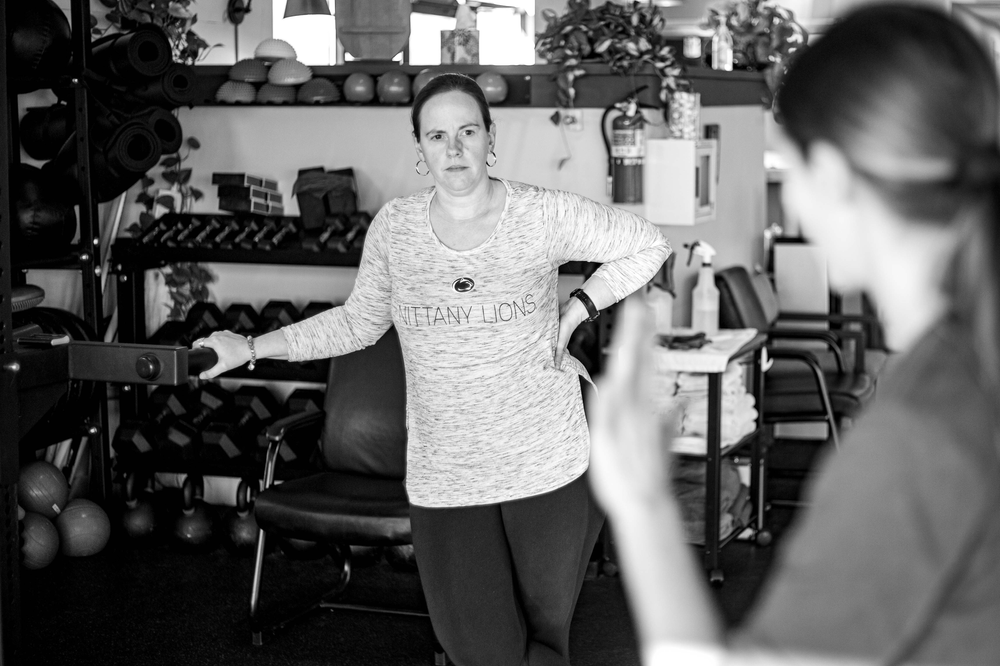
Starting with massage, stretching, and muscle loosening, Macy was able to help Jill’s nervous system calm down, enabling her to focus on specific areas of her body that required attention. n

With Tyra’s guidance, Jill learned how to strengthen and engage her core. This improved her posture, stability, balance, and reduced her risk of further injury.n

“I am now back to yoga, bike riding, playing with my kids, and walking miles at a time. I hope to continue to grow my knowledge and continue my path to a healthier lifestyle.”

If you are experiencing pain or discomfort that is interfering with your daily life, take a page out of Jill’s book and seek the help of a physical therapist. You may be surprised at the transformative results you can achieve with the right guidance and support.

Don’t wait to start living your best life. Contact Wonsettler Physical Therapy today!

Beat Stress with These 4 Simple and Effective Tips!

Stress is a common part of life, but chronic stress is not normal and leads to negative health effects. Chronic stress keeps the body in “fight or flight” mode, causing muscle soreness, fatigue, sleep disturbances, immune system issues, appetite changes, and brain fog.

To help prevent this, here are some helpful tips to alleviate stress:

  • Meditation & deep breathing: Slowing down your breath and practicing mindfulness stimulates the calming branch of your nervous system.n
  • Movement: Pick an activity such as yoga, pilates, walking, running or strength training and try to participate a few times each week. Movement can help regulate “feel good” hormones and endorphins!n
  • Social Connection: Make sure you are taking time to connect with loves ones, whether it is a phone call to a family member or going out with friends.n
  • Prioritize Sleep: Sleeping allows our system to rest and reset. If we are not getting adequate sleep, it is hard for our nervous system to regulate hormones.n

In the busy world we live in, slowing down and taking a bit of time each day is important for our health and wellbeing!

Injury to Recovery, Andi’s Physical Therapy Success Story

Injury to Recovery, Andi’s Physical Therapy Success Story

While on a trip to Nashville in November of 2021, Andi fell and broke her tibia and fibula.  She recalled the accident, “I remember getting up to use the bathroom and next thing I knew my foot was in the wall and there was a good amount of skin ripped from my face.”

She rushed to the hospital. Andi received surgery two weeks later and began physical therapy at the same facility as her procedure. However, after many visits, she wasn’t making the progress she wanted.

“I was walking like a duck. Towards the end of my care, I was just lightly walking on the treadmill. I could be doing that at home. I needed to be challenged.”

Andi’s husband was a former patient at WPT and recommended she give us a call. Our patient specialist listened to her story, and matched her with Tyra as her personal physical therapist. n

“Tyra put me to work immediately. For the first time I was leaving physical therapy sweaty. Within the first 2-3 weeks I was already noticing a difference.”

Andi put in a serious effort, and pushed through the physical exercises Tyra designed for her. Her effort paid off in a big way. Andi is now on her way to a full recovery and even has plans to do her first 5k run in 2023.

We’re cheering you on, Andi!

The Best Way to Stay Accountable!

New Year’s resolutions are a great way to focus on health goals, but they can be difficult to stick with. That’s where an accountability partner comes in. An accountability partner is someone who will help keep you on track and motivated. Some benefits of having an accountability partner include:

  1. Encouragement and motivation.
  2. Lending a listening ear when you need it.
  3. Holding you accountable for your actions.
  4. Reminding you of your goals and encouraging you to take action.
  5. Providing support and a sense of community.

An accountability partner doesn’t have to be a close friend or family member. It could be a coworker, a fellow gym member, or even a physical therapist at WPT. The important thing is that you feel comfortable and supported.

Overall, having an accountability partner can be a valuable asset in helping you achieve your New Year’s resolutions.

Transform Your Abs with These 3 Killer Exercises!

If you’re looking to tone and strengthen your abs, you don’t need to spend hours at the gym or invest in expensive equipment. There are plenty of effective ab exercises that you can do at home with minimal space and equipment. In this blog post, we’ll introduce you to three helpful ab workouts that you can easily incorporate into your fitness routine. From classic planks to dynamic bicycle crunches, these exercises are sure to challenge your core and help you achieve your fitness goals. So, let’s get started!

Planks: Planks are a classic ab exercise that work the entire core, including the rectus abdominis, transverse abdominis, and obliques. To do a plank, start in a pushup position with your hands on the floor, shoulder-width apart. Hold this position for 30 seconds to one minute, keeping your body straight and your core engaged. You can also try variations of the plank, such as side planks or plank jacks, to target different areas of the core.

Russian twists: Russian twists are a great exercise for targeting the obliques, the muscles on the sides of the waist. To do a Russian twist, sit on the floor with your knees bent and your feet flat. Hold a weight or a medicine ball in front of your chest with both hands. Lean back slightly and lift your feet off the ground, engaging your core. Rotate your torso to the left and then to the right, keeping your feet off the ground the entire time. Do 10-15 reps on each side.n

Bicycle crunches: Bicycle crunches are a dynamic exercise that works the rectus abdominis and obliques. To do a bicycle crunch, lie on your back with your hands behind your head and your knees bent. Lift your head, shoulders, and upper back off the ground. Bring your right elbow to your left knee, then switch sides and bring your left elbow to your right knee. Continue alternating sides, as if you were pedaling a bicycle. Do 20-30 reps.n

Remember to always warm up before starting any ab workout. Listen to your body and only do exercises that feel comfortable and safe for you. As you get stronger, you can gradually increase the difficulty and duration of your ab workouts.

As a reminder, exercise should not be painful. If you begin to feel any pain during these exercises, please reach out to us. We are here to help!

3 Tips for Making Your Health & Fitness Goals a Reality in 2023

As you’re setting goals and making resolutions for the new year, it’s important to take time to evaluate your current habits.

Here are some tips for evaluating your current habits:

  1. Keep a journal to track your daily activities and behaviors.
  2. Reflect on the consequences of those current habits. (How are they positively or negatively contributing to your physical health and well-being?)
  3. Decide what you need to stop doing, and replace those habits with something positive.

The habits you choose to develop will directly influence your results and help you make positive changes to your physical health and well-being.

Remember to celebrate your wins along the way!

Reach out to us for help and support on your journey.

Can Pilates help with Low Back Pain?

Does your low back pain prevent you from sitting in a comfortable position? Does it make standing for long periods of time difficult? How about driving long distances? If you are dealing with Low Back Pain (LBP), you’re not alone. 80% of people will deal with it at some point in their life. LBP is the second leading cause for disability around the world and is the most common thing we treat at here at WPT.

LBP can stem from injury or overuse and it is very treatable. The first thing to note is that staying mobile and exercising is key to healing. This is because most exercise interventions will have an effect in managing LBP. Some interventions, such as physical therapy and Pilates, prove more beneficial than others.

During PT for LBP, there is an emphasis on strengthening and stabilizing low back muscles. This includes resistance training and aerobic exercise. These movements are also both tenets of Pilates, which WPT offers twice a week.

According to The Journal of Orthopedic and Sport Physical Therapy, the most beneficial pilates routine is as follows:

  1. Take part in 1 to 2 45-60 minute sessions of Pilates or strength exercises per week.
  2. Have a blend of core-based strength and mind-body exercises.
  3. Take part in 3 to 9 weeks of Pilates and core-based exercises.

The best way to get started is to sign up for one of WPT’s Pilates classes here, or give us a call at (724) 200-7377. We are ready to answer any and all questions you may have about LBP!

Let us help you take your life back and regain your freedom from back pain!

If you’d like to read the full article you can find it here: https://www.jospt.org/doi/10.2519/jospt.2022.10671

Falling often? Learn How to Get Up Safely in a Way That Suits You!

In a previous blog post on WPT, Rachel Dziak PT, DPT, ATC talks about falls and ways to prevent them! This topic is more geared to if you have a fall or are a frequent faller how to get up safely, securely and decrease risk of further injury.

Below are videos of safe ways to get on and off the floor as well as multiple fall recovery techniques that suit you! This means there’s a technique if you have trouble getting onto your hands and knees; trouble with your shoulders or your balance! If this sounds like something that would help you please read and watch further!

This first technique is if you feel pretty strong and typically don’t need anything to perform a floor to stand transfer. In the video you will see me, Sara Ryan PT, DPT, ATC getting down onto the floor using a safe technique and then moving through a safe technique to stand. Most of these techniques follow the same start as listed below:

  1. Check for injury: move your head, arms and legs around making sure there is no significant injury to your extremities, neck or head. In some cases injuries to your neck, head or extremities would benefit from you remaining still and calling for help versus trying to get up and causing further injury.
  2. Start to move through the motions of sitting up by bending your dominant leg, reaching up with the opposite arm and rolling to your side. Then you will use your top arm to support you and help you get into a side push up position. Next you will move into a hands and knees position.
  3. Standing! If you feel confident you can now move your dominant leg forward, in the video this is the right knee, brace your arms onto your leg, lift with your legs and stand.

Technique for those with weaker lower extremities or balance difficulties:

This technique follows the same steps 1. and 2. As listed above but for step 3. Instead of resting your hands on your knees to stand you want to use something stable such as a table, couch or chair to brace your upper extremities on to help you complete the transfer.

Technique for those who have a stronger upper body, weaker lower body or difficulty getting into lunge position.

In this technique step 1. And 2. Are the same you are then going to crawl to an object and move back onto your butt with a stable surface such as a table pushed against a couch or a couch. This technique you will reach your hands or elbows behind you which requires good shoulder mobility and strength. You will then tilt back utilizing a bridge technique and “shimmy” onto the couch until you have your sits bones to the point where you can shift to sit up

** Part two of this technique is if you do not have the shoulder mobility to strength to reach up onto the couch. If you are able to sit on a couch cushion, stable stack of books or a stool. This will break the technique up into two steps requiring you to move your shoulders back less and less shoulder strength to complete the transfer.

Technique for those who may have trouble bearing weight onto their knees or are unable to get their hips into the “lunge” position.

In this technique 1. And 2. Are the same but once you get to hands and knees you are going to straighten your legs and put all your weight into your feet and walk your hands back until you are able to shift all of your weight into your feet and stand up or walk up your legs to stand.

Pain as an Alarm System

As patients attending physical therapy, many of us are struggling with pain. Pain is actually a normal part of the human experience of living, however living every day with pain is NOT normal! If you are currently living every day in pain, then this story can help you to understand why.

I want you to imagine you are walking along, then you step on a rusty nail that punctures your foot. How do you know (without looking) that there is a nail in your foot? Let’s consider this, our body actually possesses the most unique alarm system in the world, our nervous system. The nervous system houses 45 miles of nerves within it, that’s pretty amazing!

When we step on the nail, the alarm (nervous system) is activated. A message fires from the foot into the nerves to the spinal cord and finally to the brain. What would your next steps be after stepping on the nail? Likely you would have the nail removed, the wound would be cleaned, bandaged then a tetanus shot would be administered. After we remove the nail, does the pain go away right away? No, of course not! Our alarm system wants to ensure that we are okay, so the pain decreases overtime!

If you are struggling with chronic pain, what happens to make the pain levels remain present even after healing occurs with time? We know that after an injury, 1 in 4 people will have the alarm system remain triggered moving into ‘high alert mode’. This high alert mode leaves the body more sensitive to stress including movement, activities, emotional stressors and even temperature. Tasks or movements that previously may not have activated the alarm system now do, and we experience pain with previously benign movements.

A question commonly asked is, ‘Why did my alarm system stay elevated in high alert mode?’. The answer is many things contribute to forming this elevated state including traumatic experiences upon initial injury such as a car accident or a slip on ice. Other things like financial strain, relationship issues, troubles at work and fear for the future can lead to the elevated alarm system. The good news is, there are techniques that can be done to restore the sensitivity of the nervous system. If this is something you are struggling with, reach out to your trusted physical therapist at WPT!

References:

Louw A, Zimney K, O’Hotto C, Hilton S. The clinical application of teaching people about pain. Physiotherapy Theory and Practice. Jul 2016;32(5):385-395.

Louw A, Puentedura E, Zimney K, Cox T, Rico D. The Clinical Implementation of Pain Neuroscience Education: A Survey Study. Physiotherapy Theory and Practice. 2017 – accepted for publication.

Proper Hydration

As temperatures lower one topic that usually gets on the back burner is hydration. Are you drinking enough to ensure you are replacing the electrolytes and nutrients we lose when we sweat? We’ve all heard we need to stay hydrated and need to drink water, but how much are we supposed to? Some people stick to 8 glasses of water, some stick to half of our body weight in ounces, and some people think if you wait until your thirsty, you’re already dehydrated. We’ve done some digging and found The U.S. National Academies of Sciences, Engineering, and Medicine recommends that daily amount of water should be about 15.5 cups (3.7 liters) of fluids a day for men and 11.5 cups (2.7 liters) of fluids a day for women.

Now, that seems like a very intimidating number but what we always fail to remember is how much water we are getting from the food we eat. A lot of fruits and vegetables are made up of so much water it can help contribute to our daily intake. Another food that can help us in these winter months is soups and stews since they contain a lot of liquid to replenish what our bodies use throughout the day. But not all foods and beverages are created equal. Some liquids that contain excessive caffeine and sugar which could be causing more harm than good. Keep an eye on ingredients because even drinks labeled ‘healthy’ or ‘sports’ drinks can contain a bunch of hidden sugar and calories.

Our bodies are made of about 50-70% of water so it’s really important to make sure we replace all that water we lose inorder to make sure our bodies continue to functional properly. The important thing to keep in mind when you are outside in cool weather is water can actually help our bodies regulate temperature. A couple other “cool” facts about water are: it will help us gets rid of toxins, lubricates and cushions our joints and discs, and protects sensitive tissues. If trying keep track of certain water amounts is too much a good way to track hydration level is to track your urine color. If you are properly hydrated it should be a colorless or light yellow color.

As with everything, do your own research and talk to your doctor about whats right for you. Your doctor or dietitian can help you determine the amount of water that’s right for you every day.